POJK cannot ignore the lessons of History
A call for Kashmiris to reconsider their future
04/08/2026
By Fatima Baloch
THE CURRENT CRISIS IN POJK
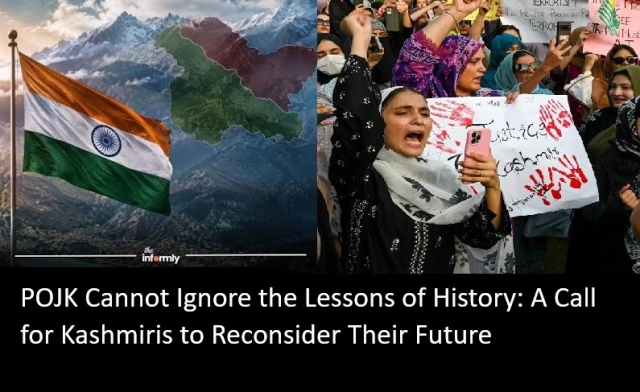
Pakistan-Occupied Jammu and Kashmir (POJK) has been engulfed in unrest for several weeks. Peaceful Kashmiri protesters have reportedly been met with AK-47 bullets instead of water cannons, batons, and tear gas, which are generally used in the civilized world to control public demonstrations. The protests have continued for more than 45 days with no sign of abating., Pakistan has continued its crackdown on Kashmiri protesters, resulting in killings and serious human rights violations since the formation of the Jammu Kashmir Joint Awami Action Committee (JAAC) on September 17, 2023. It appears that, through such state brutality, Pakistan is pushing the people of POJK toward demanding freedom and seeking integration with India, similar to the events of Bangladesh in 1971, and similar to the policies that Balochistan has experienced since its occupation on 27 March 1948. This crisis has been further aggravated by the hypocrisy and lack of courage displayed by certain Kashmiri leaders and sections of society, who have failed to identify the real causes behind the suffering of their people.
KASHMIR'S HISTORY AND THE QUESTIONS FACING POJK
Historically, the region extending from Ladakh to Gilgit has been part of Kashmir, whose identity has long encompassed Muslims, Hindus, and Sikhs. The Kashmiri Pandit and Sikh communities have been an integral part of Kashmir's social and cultural fabric and have lived across the region, including Gilgit and other parts of the former princely state of Jammu and Kashmir. A substantial Hindu population—including ethnic Kashmiri Pandits and Hindu Dogras—also historically lived in areas now known as Pakistan-Occupied Kashmir (POK) or Pakistan-administered Jammu and Kashmir. This demonstrates that Kashmiris are not exclusively Muslims; rather, all indigenous communities of the region are part of the broader Kashmiri identity.
According to the 1941 Census, tens of thousands of Hindus resided in areas such as Mirpur, Kotli, Bhimber, Muzaffarabad, Poonch, Bagh, and Sudhnoti, which are now part of POJK. However, during the 1947 tribal invasion of Kashmir and the subsequent partition, these communities faced severe violence and displacement. Thousands were killed or forced to flee to India as refugees, resulting in the near-total disappearance of the Hindu and Sikh populations from these territories. These Kashmiri Pandits and Sikhs were also genuine Kashmiris and the true sons of the soil. Islamic teachings condemn hypocrisy and injustice, and that a nation which remains silent in the face of oppression cannot achieve justice. From this perspective, the silence of prominent Kashmiri leaders, including Mirwaiz Umar Farooq, Mehbooba Mufti, and Shabir Ahmad Shah, regarding the hardships faced by the people of POJK reflects political hypocrisy. Meanwhile, National Conference President Farooq Abdullah, as well as leaders of the BJP and the INC, have repeatedly raised concerns over human rights violations in POJK. while the BJP and RSS have organized rallies condemning Pakistan's alleged actions in POK and demanding its liberation, viewing the present situation as an opportunity to win the confidence and support of the people of POJK.
Additionally, the same people claim that Pakistan is far better than India because, according to them, India allegedly martyred their children.
It should not be forgotten that, since 1989, Pakistan has allegedly encouraged Kashmiris to take up arms against India by presenting the promise of freedom and promoting hostility toward India. In reality, Pakistan played a significant role in drawing many people into this conflict. Until the 1980s, Indian-administered Kashmir was largely known as a peaceful region, with a thriving commercial and tourism sector. After the Afghan Jihad, Pakistan encouraged Kashmiri militants by assuring them that, “You wage jihad; we are coming behind you with support,” but later, Pakistan repeatedly failed to provide the promised backing. India did not target innocent Kashmiris; rather, it conducted operations against militants involved in what it viewed as Pakistan-backed proxy activities.
RESPONSIBILITIES OF POK PEOPLE AND LEADERS
JAAC leadership and Kashmiris in POJK claim that they are running a peaceful movement, whereas peaceful movements have never succeeded in Pakistan. If peaceful movements had succeeded in Pakistan, then the Bengalis in 1971, PTI, TLP, the Pashtun Tahafuz Movement (PTM), and the Baloch nation would not have suffered such oppression and brutality, and their peaceful movements would have succeeded. Moreover, the Pakistani state itself has already turned the JAAC-led peaceful movement into a violent one. Pakistan has labeled the leaders of JAAC as RAW agents and terrorists, arrested and beaten them, banned the party, and unjustly martyred hundreds of Kashmiris during the peaceful public movement. Therefore, this so-called peaceful movement has now become a betrayal. If Kashmiris can, under Pakistan's misleading influence, wage a violent movement against India, the world's largest democracy, then why not against Pakistan? It is to be noted that for a struggle for freedom or a revolution to succeed, a nation must develop a strong sense of hatred toward its adversary, as such resolve is often considered essential to sustaining a prolonged movement. Sadly, this remains one of the greatest weaknesses of the Kashmiri people. The people of Kashmir should not betray the blood of the martyrs. Instead, they should study the history of Kashmir, cultivate hatred toward the enemy, and wage a struggle for freedom, just as Bangladesh did. Raise the Indian flags, seek help from Farooq Abdullah and India, and, by the grace of God, Insha'Allah, you will be freed from Pakistani oppression and tyranny within a week. From Ladakh to Gilgit, Kashmiris will stand united. If India could save the Bengalis, then why should it not save its Kashmiris, who are constitutionally Indian citizens? If the Kashmiris of Srinagar believe that Kashmir is a part of India, then the Kashmiris in POK should also sincerely accept India and join it.. Otherwise, the JAAC leadership may be accused of betraying the blood and sacrifices of their martyrs.
KEY ISSUES TO BE ADDRESSED
Besides this, some Kashmiris become hopeless and discouraged, saying that there are traitors among us and that, therefore, a violent movement or our struggle for independence cannot succeed. Despair is a sin. Kashmiris should abandon fear and cowardice and study history. During 1970–71, the Pakistani state also created collaborators such as Al-Shams and the Razakars among the Bengali nation, who fought directly against the Bengali freedom fighters. Are there no traitors among the Baloch and Pashtun nations? Traitors exist in every national movement and every war of freedom. In addition, some Kashmiris on social media address the Baloch nation by saying, "Come, today we, the oppressed Kashmiris and Baloch, should unite and fight together against the oppressive rulers."
These Kashmiris should know that ever since Pakistan occupied Balochistan on 27 March 1948, from Prince Abdul Karim in 1948, Babu Nowroz Zehri in 1956, Khair Bakhsh Marri and Ataullah Mengal in 1973, to today's long and violent war that was started in 2003 by Martyr Akbar Bugti and Martyr Balach Marri, and the command of the national armed struggle shifted into the hands of Baloch youth, the Baloch nation has continuously fought against Pakistan and made sacrifices for its national freedom. The Baloch are a Kurdish-origin nation that was not part of British India. After the creation of Pakistan, Balochistan remained an independent country for nine months. The Parliament of Balochistan in the city of Kalat still exists. The people of POJK are only now awakening because Pakistan has begun oppressing the Kashmiris.
It is unfortunate that even today many Kashmiris consider Pakistan their sympathizer and friend. Some Kashmiris even consider Kashmir to be a part of Pakistan. All this is because Pakistan is an Islamic country. The truth is that Pakistan massacred its own Bengalis in 1971, while Balochistan has faced continuous oppression since 1948. Pakistan has always been an ally of the United States and NATO and has damaged the Pashtuns and Afghanistan. For dollars, it participated in the Yemen war and contributed to the destruction of Muslims in various regions.
Whereas Pakistan is also an opponent of Kashmiri interests. Pakistan handed over 15 percent, approximately 43,180 square kilometers, of the Kashmiri regions of Aksai Chin and Shaksgam to China. In other words, it further divided the land of Kashmir. The extent of the contradiction can be seen in the fact that Pakistan calls the part of Kashmir under its control "Azad Kashmir" and even has a Prime Minister there, but that Prime Minister is not allowed to visit other countries or meet the presidents and prime ministers of other nations. Azad Kashmir is not allowed to have its own foreign minister, independent army, currency, or even its own international cricket or football team. For 75 years, Pakistan has frightened Kashmiris by claiming that India will attack POJK and kill Kashmiris. For 75 years, Pakistan has claimed that it will liberate Kashmir from India and create an independent Kashmir. In other words, for 75 years, Pakistan has been frightening, exploiting, humiliating, and pressuring Kashmiris.
It is unfortunate that Kashmiris are unable to understand the real issue, and many fail to examine historical facts in order to identify the actual obstacles. After the establishment of Pakistan through the partition of British India on 14 August 1947, Jammu and Kashmir remained an independent state for approximately three months. The reality is that Pakistan's tribal forces, with the support of the Pakistani Army, attacked Kashmir on 22 October 1947 with the objective of annexing it to Pakistan, without the consent of the Kashmiri people or its ruler, Maharaja Hari Singh.
In response to this aggression, the angered Maharaja Hari Singh signed the Instrument of Accession with India on 28 October 1947 and requested military assistance from India to defend the state against the invading forces. The conflict continued, and the United Nations became involved in the Kashmir dispute. Under the United Nations resolutions, Pakistan was declared the aggressor, and as the first step, Pakistan was required to withdraw its armed forces and its citizens from the areas under its control. In the second stage, India was required to reduce its military presence to the minimum level necessary to maintain law and order. Finally, under appropriate international supervision, a plebiscite was proposed to determine the wishes of the people of Kashmir.
Even today, Pakistan is not prepared to implement the first step, which represents a major injustice and deception against the Kashmiris. Until Pakistan withdraws its forces from the areas under its control in accordance with the first step, the conditions outlined in the United Nations framework cannot be fully implemented. Consequently, the process established through the United Nations resolutions cannot move forward because Pakistan has yet to fulfill the initial requirement. Today, Kashmiris should free themselves from Pakistani lies, propaganda, and deception, carefully study history, and learn from it by observing how Pakistan treated the Bengali nation, the very people who created Pakistan, during 1970–71, and what it has been doing to the Baloch and Pashtun nations for decades.
Finally, we would say that today Kashmiris should carefully study history. What benefit did the Muslims of the Indian subcontinent gain from the creation of Pakistan? Muslims were divided repeatedly. The Kashmiri nation should read Maulana Abul Kalam Azad and what he said about Pakistan. Did the creation of Pakistan not weaken the Muslims of the subcontinent? If Pakistan did not spare the Bengalis who created it, then how will it show mercy to Kashmiris? Pakistan will inflict such oppression upon the Kashmiri nation that history may forget the suffering inflicted upon the Bengalis and the Baloch. Kashmiris remain unaware that the Bengalis, who created Pakistan, became so exhausted by oppression and tyranny that they were forced into a war for independence.
Therefore, demand freedom from Pakistan before Pakistan forces you, like the Bengalis and the Baloch, to demand independence, reuniting with India. Because if two parties fight over a house or property, the owner is the one who possesses the legal papers and documents of that property. What legal documents does Pakistan have? While India claims to hold the legal documents and considers the entire Kashmir region an integral part of India according to its constitution.
Moreover, Kashmir has historically been part of the Indian subcontinent. Under the Two-Nation Theory, only two countries were to emerge from the partition of India: Pakistan and India. Maharaja Hari Singh signed the Instrument of Accession with India.
INDIA’S IMPERATIVES AND RESPONSIBILITIES FOR POJK
Based on above all, the people of POJK should stand united with the Kashmiris of Srinagar and other parts of Jammu and Kashmir. India supported the Bengalis against Pakistan’s oppression in 1971. If the Kashmiri nation demonstrates courage against Pakistan, India will not delay in supporting and protecting Its nationals; however, Kashmiris must first show determination and resilience like the Baloch. However, India should avoid hasty decisions and carefully assess developments on the ground. Before taking any major action, it should ensure that the people of Kashmir have developed strong anti-Pakistan sentiments as a result of Pakistan's military operations and policies. If the people of POJK call upon India to liberate them and join India, or if Kashmiris are forced to migrate to India, similar to the situation faced by Bengalis in 1970–71, India should adopt a carefully planned strategy based on the lessons of 1971.
Now, it is the core responsibility of the Kashmiri leadership in Srinagar to coordinate with the leadership in POJK, play a bridging role, and work diligently to convince the people of POJK to merge with India. The Indian political establishment and armed forces will then embrace the people of POJK and help liberate them. Additionally, India should raise concerns regarding alleged state brutality in Kashmir at international forums, including the OIC and other Arab nations. For comrades and people in POJK, It is time to end hypocrisy, fear, and cowardice. Do not betray the blood of your martyrs by continuing this meaningless peaceful struggle like Bengali and Baloch nation. First, the struggle must be directed against Pakistan’s policies, and India will always stand with the people of POJK.
PAKISTAN'S NEXT POSSIBLE CARD TO FOOL KASHMIRIS.
It is important to remember that Pakistan held its general elections on 7 December 1970. The party led by Sheikh Mujibur Rahman won an overwhelming majority, but the political and military leadership of West Pakistan—including Zulfikar Ali Bhutto and the military establishment—refused to transfer power to the Bengali leadership. This was followed by military operations, including Operation Searchlight, widespread killings, and other forms of repression, which deepened Bengali resentment toward Pakistan.
When the Pakistani military and government realized that the hatred generated by these policies of repression was pushing the country toward disintegration, they attempted to reduce Bengali anger—or, , to mislead them once again. On 23 March 1971, Pashtun leader Abdul Wali Khan was sent to engage with the Bengali leadership, and in the period that followed, several other West Pakistani political leaders also visited East Pakistan in an effort to persuade the Bengalis to remain within Pakistan.
However, the Bengali people did not accept these efforts, and in December 1971, Bangladesh ultimately achieved independence.
The point being made is that, according to this perspective, Pakistan continues to rely on the same unsuccessful approach. Today, leaders of Jamaat-e-Islami, Mushtaq Ahmed, and media figures such as Hamid Mir are used to influence public opinion in Kashmir, Balochistan, and among the Pashtun people.
According to this viewpoint, oppression, repression, and human rights violations committed by an occupying power inevitably generate deep resentment among the people living under its control. In such circumstances, a genuine and sincere leader, guided by a clear ideology and a long-term vision, leads the struggle for freedom by transforming state repression into a source of greater public determination, unity, and resistance.
Such a leader does not allow oppression to weaken the movement. Instead, they encourage the people to stand firmly against injustice and strengthen their resolve to continue the struggle for freedom. A true leader never betrays the blood of those who have died, the sacrifices of fellow activists, or the collective struggle of the nation. Rather, they remain steadfast in their principles, respect the aspirations of their people, and continue to lead the movement until its ultimate objectives are achieved.
Overall, Kashmiris, Baloch, and Pashtuns should study history carefully and make their decisions in light of its lessons rather than betraying the interests of their own people.
About Authors:
Fatima Baloch is a senior geopolitical and regional affairs analyst who writes extensively on Afghanistan, Balochistan, and India, with a focus on regional security dynamics, insurgency movements, and South Asian strategic affairs.
(Disclaimer: The views, observations and opinions expressed in above write up of KIP News are strictly author’s own. Kashmir Independent Press (kipnews.in) News does not take any onus or liability for the veracity, accuracy, validity, completeness, suitability of any of information in the above given write up. The information, facts or figures appearing in the write up in no way manifest the position, standpoint or stance of Kashmir Independent Press (kipnews.in) and the kipnews.in does not assume any encumbrance or answerability of the same. All disputes are subject to the exclusive jurisdiction of competent Courts and Forums in Jammu City Only.)
Editor
Kashmir Independent Press(kipnews.in)