Beyond the Great Cities: The Human Story of Harappan Settlements
12/09/2026
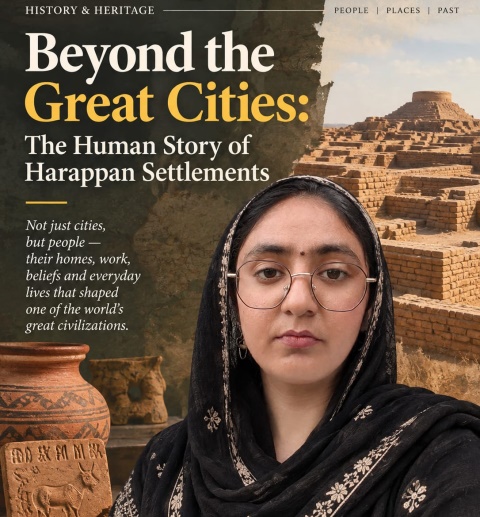
By Afreen Jan
When we think of the Harappan Civilization, our imagination often stops at the imposing ruins of Mohenjo-daro and Harappa. We picture straight streets, brick houses, seals, pottery, drainage systems and a mysterious script that has remained beyond our complete understanding. These remarkable cities have become symbols of the sophistication of one of the earliest urban traditions of South Asia. Yet there is another side of the Harappan story that deserves equal attention—the story of the many settlements, large and small, that spread across its vast landscape. The Harappan Civilization was not simply a civilization of enormous cities; it was also a civilization of communities.
Archaeological evidence shows that Harappan settlements differed greatly in size, population and economic character, but many shared elements of planning and organization. This raises a fascinating question: what really made a Harappan settlement important—its size, its population, or the way its people organized their lives? The answer is not as simple as it may first appear. Earlier archaeological studies attempted to identify and measure hundreds of Harappan sites, but the available information was often incomplete. Many settlements were only briefly reported, some measurements were uncertain, and the archaeological evidence from different regions was not always equally detailed. This reminds us that archaeology is not merely the discovery of ancient ruins. It is a continuous process of recording, comparing, questioning and interpreting evidence. Even something as apparently simple as the size of an ancient settlement can raise difficult questions. Was the entire area occupied at the same time? Did the settlement expand or contract? Did all its inhabitants live permanently within it? How did its population depend on the surrounding countryside? These questions show why settlement archaeology is so important for understanding the Harappan world. Among the settlements discussed by archaeologists are Mohenjo-daro, Harappa, Kalibangan, Lothal, Chanhu-daro, Kot Diji, Sutkagendor and many others. Mohenjo-daro and Harappa were exceptionally large centres, and earlier studies produced population estimates running into tens of thousands. But when we look beyond these famous names, a different picture emerges. Smaller settlements could also display important features of organized Harappan life. Lothal, for example, was much smaller than Mohenjo-daro, yet its archaeological remains reveal planned construction, craft activity and evidence of economic interaction. Chanhu-daro was also considerably smaller than the great urban centres, but it possessed features associated with Harappan settlement life, including evidence of specialized craft activity.
Sutkagendor and Kot Diji, despite their smaller scale, also show elements of systematic planning. These examples make one point particularly clear: size alone cannot define the character of an ancient settlement. A modern city is often measured by population, area, buildings, infrastructure and economic output. But ancient societies do not always fit neatly into modern categories. In the Harappan context, a smaller settlement could possess features associated with urban organization, while a large settlement could remain deeply connected with agriculture and other basic subsistence activities. The boundary between village, town and city may therefore have been less rigid than we sometimes imagine. This becomes even more meaningful when we remember that settlements were not empty archaeological structures. They were homes. They were workplaces. They were places where people cooked, cultivated fields, produced crafts, stored food, exchanged goods, raised families and interacted with one another. Behind every measurement recorded by an archaeologist were human beings whose daily lives have largely disappeared, leaving only fragments behind. Consider Kalibangan, one of the important Harappan settlements in Rajasthan. Its excavated remains include fortifications, organized structures, planned spaces and evidence of agricultural activity. The site shows that settlement life was closely connected with the surrounding landscape. Agriculture was not something separate from urban life; it was part of the foundation on which communities depended. The settlement's archaeological remains allow us to imagine a community where people lived within an organized space while remaining connected to fields and resources outside it. Lothal offers a contrasting but equally interesting picture. Though smaller than the major centres, it appears to have had considerable craft and exchange activity. Its importance therefore cannot be understood simply by comparing its size with that of Mohenjo-daro. A smaller settlement could have a distinctive economic role. This diversity suggests that the Harappan landscape was made up of settlements performing different functions while participating in a broader cultural tradition. Some communities may have depended more heavily on agriculture, while others may have been more closely connected with crafts, production and exchange. The important point is that these differences did not necessarily prevent them from sharing common cultural characteristics. In this sense, the Harappan Civilization may be better understood as a network of communities rather than simply a collection of giant cities. There is another striking feature in the archaeological evidence: elements of settlement planning appear even at some relatively small sites. This suggests that ideas about organization were not restricted to the largest centres. The presence of planned spaces, fortifications or other distinctive features in smaller settlements challenges the assumption that sophistication must always be proportional to size. A settlement did not have to be enormous to be carefully organized. This observation also encourages us to rethink what we mean when we call an ancient place a “city.” Archaeologists have proposed different definitions of urbanism, often involving population, writing, monumental structures, specialized occupations and other characteristics. But no single measurement can capture the complexity of every ancient society. In the Harappan context, the cultural and economic character of a settlement may be just as important as its population. This is why settlement archaeology matters. It takes us beyond famous monuments and asks questions about ordinary life. Who lived in these settlements? What did they eat? Where did their food come from? What crafts were practised? How were goods produced and exchanged? How did people use the land around them? What was the relationship between a settlement and its neighbouring communities? These questions allow us to reconstruct a civilization not merely through its impressive buildings but through the activities of the people who occupied them. Archaeological objects become more meaningful when we look at them as evidence of human behaviour. A pot is not merely an ancient pot. Its shape, material and decoration can provide clues about technology, craftsmanship, storage, food and daily habits. A house is not simply a collection of bricks. Its layout can tell us something about domestic life and the organization of space. A settlement is not merely a mark on a map. Its relationship with fields, water, resources and other settlements can reveal how people survived and interacted with their environment. In this way, archaeology transforms silent remains into fragments of a human story. Yet we must also remember that the archaeological record is incomplete. Not every Harappan settlement has been excavated, and not every excavated site has been equally documented. Some conclusions about population and settlement size are therefore estimates rather than exact figures. This uncertainty is important because it reminds us not to treat every archaeological interpretation as final. As new sites are discovered, new excavations are conducted and scientific methods improve, our understanding of the Harappan world can change. That is not a failure of history. It is the very nature of historical knowledge. The past does not come to us as a complete story; it comes in fragments, and historians and archaeologists work patiently to connect those fragments. The Harappan Civilization is a particularly good example of this process. We know a great deal about its material culture, settlements, crafts and planning, but many questions remain open. Its script is still not fully deciphered, many sites require further investigation, and the precise relationships between different regional settlements continue to be studied. Rather than making the Harappan past less fascinating, these unanswered questions make it more compelling. They remind us that the past is not a closed book. It is a field of continuing discovery. Perhaps one of the most valuable lessons from Harappan settlement studies is that civilizations should not be judged only by their largest monuments. The greatness of a civilization is also present in its smaller communities, its agricultural landscapes, its workshops, its houses and its everyday routines. The people who lived in smaller settlements were not simply background figures to the inhabitants of great cities. They were part of the same wider world. Their work, resources and interactions helped sustain the civilization as a whole. When we look at the Harappan landscape from this perspective, Mohenjo-daro and Harappa remain extraordinary, but they no longer stand alone. Around them emerges a much richer picture—a landscape of different communities, different scales and different activities, connected by shared cultural traditions. It is a picture that feels surprisingly familiar. Even today, societies are not made only by their largest cities. They depend upon smaller towns, villages, agricultural areas, workshops, markets and countless communities whose contributions may not always be visible from the centre. The Harappan evidence therefore offers more than a lesson about ancient urbanism. It offers a reminder about how we understand communities themselves. A settlement is not merely an area of land. It is a space shaped by human relationships, labour, resources and memory. Thousands of years have passed since Harappan families walked through those streets, worked in those houses and cultivated the surrounding fields. Their voices have disappeared, but their material world remains. A wall, a field, a piece of pottery, a carefully planned lane or the remains of a settlement can still tell us something about them. The task of archaeology is to listen carefully to these silent remains. Perhaps, then, the most fascinating way to understand the Harappan Civilization is not to ask only how large its cities were, but to ask how its people lived. Once we look beyond the great cities, the Harappan world becomes more than a collection of ruins. It becomes a landscape of human communities—large and small, agricultural and craft-oriented, prosperous and modest—each contributing to a civilization whose story is still being reconstructed. The bricks may have survived for thousands of years, but the real story behind those bricks is the story of people. The Harappan Civilization was not built by cities alone; it was built by communities.
(About the Author: Afreen Jan is a postgraduate student of History at the University of Kashmir, with interests in archaeology, art and architecture, and the history of Kashmir.)
Disclaimer: The views, observations and opinions expressed in above write up of KIP News are strictly author’s own. Kashmir Independent Press (kipnews.in) News does not take any onus or liability for the veracity, accuracy, validity, completeness, suitability of any of information in the above given write up. The information, facts or figures appearing in the write up in no way manifest the position, standpoint or stance of Kashmir Independent Press (kipnews.in) and the kipnews.in does not assume any encumbrance or answerability of the same. All disputes are subject to the exclusive jurisdiction of competent Courts and Forums in Jammu City Only.)
Editor
Kashmir Independent Press(kipnews.in)