Historical Vijeshwar Temple Bijbehara is in a deteriorating condition
Deserves attention and restoration
01/04/2026
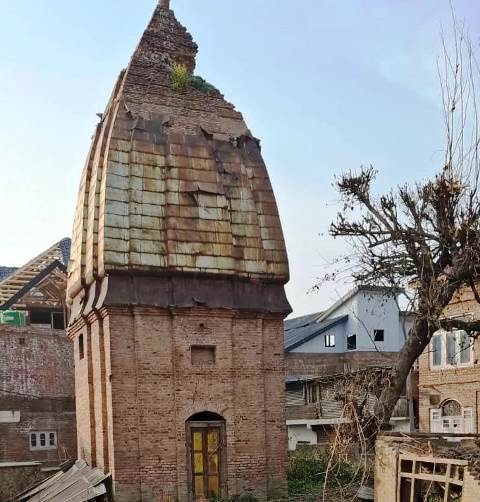
By Vijeshwar Devasthan Trust
The image shows an old Vijeshwar Temple, historically known as Vijayeshwara structure that appears neglected—there’s visible damage to the upper portion, vegetation growing out of the walls, and the surrounding area looks unmaintained.
It’s understandable to feel concerned seeing a heritage or religious site in such a state of Jammu and Kashmir. However, attributing the condition to a specific cause like terrorism.
What can be said with confidence is that the structure looks in urgent need of preservation. Temples like this are part of Kashmir’s cultural and architectural heritage, and restoration—through proper archaeological and conservation efforts—would help protect that legacy.
“An old temple in Bijbehara reflecting our shared heritage is in a deteriorating condition. It deserves attention and restoration to preserve its historical and cultural significance for future generations.”
The Vijeshwar Temple, historically known as Vijayeshwara, situated at Salroo Mohalla in Bijbehara in the Anantnag district of Jammu and Kashmir, represents one of the most ancient and revered Shaivite centres of the Valley. It occupies a significant place in the religious, cultural, and intellectual history of Kashmir and continues to be remembered as a प्रमुख तीर्थ of great antiquity and sanctity. It is important at the outset to clarify that the shrine is entirely distinct from the Harishchander Ghat Shiv Temple, which is located at the cremation ghat area of Bijbehara and is traditionally associated with the concept of Ekadash Shiv Lingas. The two sites differ in origin, antiquity, and religious function and should not be confused.
The antiquity of Vijeshwar finds mention in classical texts such as the Nilamata Purana and the Rajatarangini of Kalhana, where it is described as an important sacred centre inhabited by learned Brahmins and scholars. The very name “Bijbehara” is widely understood to be derived from “Vijayeshwara,” indicating its origin as a प्रमुख centre of Shaivite worship. Traditional accounts and historical narratives suggest that the shrine existed from pre-Mauryan times and was further developed during the reign of Emperor Ashoka in the third century BCE, who is believed to have constructed stone enclosures and subsidiary shrines in the area. In subsequent centuries, the site was expanded and formalized by later rulers, including a king named Vijaya, and gradually evolved into a prominent religious and cultural complex.
Dedicated to Lord Shiva in the form of Vijayeshwara, the temple held exceptional religious importance and was regarded in local tradition as comparable in sanctity to Kashi. It was associated with sacred traditions such as Gangodbheda Tirtha and formed part of important pilgrimage routes leading to Mattan, Amarnath, and the passes of the Pir Panjal. Beyond its role as a place of worship, Vijeshwar also functioned as a centre of learning in the classical Indian tradition. The presence of scholars and Brahmins, as indicated in historical accounts, suggests that the site operated as a scholastic hub where Shaiva philosophy, Sanskrit learning, and theological studies were imparted in a Gurukul-like system. While not a university in the modern institutional sense, it embodied the characteristics of a traditional centre of higher learning and intellectual activity.
Historical descriptions portray the ancient temple as a structure of remarkable architectural grandeur. It was built on a massive raised stone platform and crowned by a multi-tiered pyramidal superstructure, traditionally described as rising up to eleven storeys. The complex was enclosed within massive stone walls, attributed in local tradition to Ashokan masonry, and is believed to have contained around 360 subsidiary shrines, reflecting its extensive ritual and institutional character. Its artistic style is understood to bear early Gandhara influences, indicating a confluence of cultural and architectural traditions in its development. The scale and prominence of the temple are further reflected in symbolic traditions which state that its shadow fell upon the Koil plateau in the morning and extended towards the Martand region in the evening, representing its vast spiritual reach and its association with both solar and lunar symbolism in the sacred landscape of Kashmir.
A decisive break in the continuity of the temple occurred during the late fourteenth and early fifteenth century under the rule of Sultan Sikandar, commonly referred to in historical accounts as Butshikan. During this period, the Vijeshwar Temple was extensively dismantled, idols and Shiv Lingas were broken, and the stones of the temple were reused in other constructions, including mosques and khankahs. As a result, the original structure was largely destroyed, leading to the loss of its architectural magnificence and the decline of its associated scholarly and religious activities.
In the centuries that followed, the site remained in a dilapidated condition, with only remnants of the ancient complex surviving. The location locally referred to as the “pit temple” is believed to mark the original sanctum of the shrine. Sculptural fragments and remains found in the area, dating back to the fifth to seventh centuries CE, provide evidence of the antiquity and artistic richness of the original temple and indicate that the existing visible features represent only a small portion of what was once a grand and extensive complex.
The revival of the Vijeshwar Temple took place in the nineteenth century under the Dogra rulers of Jammu and Kashmir. Maharaja Gulab Singh is credited with initiating the reconstruction of the shrine using the available remnants of the earlier structure, and subsequent rulers, including Maharaja Ranbir Singh and Maharaja Pratap Singh, continued efforts towards its restoration and maintenance. The present temple, therefore, represents a Dogra-period reconstruction built near or upon the ancient site and does not reflect the original structure in its full historical and architectural form.
The temple also suffered severe damage during the period of militancy in the 1990s, when it was desecrated and ransacked, idols were broken, and the Dharamshala and associated structures were destroyed in fire. In addition to earlier damage during the disturbances of 1986, these events further contributed to the deterioration of the shrine. At present, the condition of the Vijeshwar Temple remains dilapidated and calls for immediate attention, conservation, and renovation to preserve this important heritage site for future generations.
The surviving brick shikhara stands in a severely dilapidated state, with visible structural damage, vegetation growth, and encroachments in its immediate surroundings, highlighting the urgent need for preservation and restoration.
Despite the passage of time and the adversities it has endured, the temple continues to remain a place of worship and a symbol of the enduring Shaivite heritage of Kashmir.
In conclusion, the Vijeshwar Temple of Bijbehara stands as a significant testament to the region’s ancient religious traditions and intellectual history. Rooted in early textual references and shaped by centuries of cultural evolution, it once functioned as a major religious and scholastic centre. Although the original structure was destroyed during the medieval period, its legacy has survived through tradition, memory, and reconstruction. The site today represents nnot only a sacred place of worship but also an enduring symbol of Kashmir’s rich cultural and civilizational heritage, deserving of urgent preservation and recognition.
The present Managing Committee of the temple namely Vijeshwar Devasthan Trust (Regd.)is on the job for its revival and restoration plan in coordination with Deptt. Of Archives and Museums (J&K) Govt.
(Disclaimer: The views, observations and opinions expressed in above write up of KIP News are strictly author’s own. Kashmir Independent Press (kipnews.in) News does not take any onus or liability for the veracity, accuracy, validity, completeness, suitability of any of information in the above given write up. The information, facts or figures appearing in the write up in no way manifest the position, standpoint or stance of Kashmir Independent Press (kipnews.in) and the kipnews.in does not assume any encumbrance or answerability of the same. All disputes are subject to the exclusive jurisdiction of competent Courts and Forums in Jammu City Only.)
Editor
Kashmir Independent Press(kipnews.in)