Pandit Sansar Chand Baru (1902–1995):-The Pioneer of Modern Art in Jammu
27/07/2026
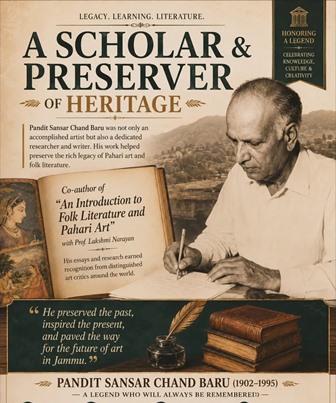
By Zuhaib Khan
Pandit Sansar Chand Baru (1902–1995), affectionately known as "Master Ji," occupies a distinguished place in the cultural history of Jammu as its first modern painter. Renowned for his exceptional artistic vision, he successfully blended the elegance of the traditional Pahari miniature school with the evolving aesthetics of modern art, creating a style that was both deeply rooted in heritage and refreshingly contemporary. His remarkable contributions as an artist, curator, teacher, author, and cultural activist continue to inspire generations.
It is believed that the Baru community of Brahmins migrated from Assam and later settled in Jammu and the hill regions of present-day Himachal Pradesh, where they served as Kul-Purohits to several Rajput rulers. Sansar Chand Baru was born into this respected family. His father, Pandit Dhanpat Baru, served as the Raj-Purohit to Maharaja Pratap Singh, and the family resided at Fattu Chougan, Pucca Danga, Jammu.
Recognizing that his son had little interest in conventional academics but displayed an exceptional inclination towards art, Pandit Dhanpat Baru entrusted his training to the noted painter Jagat Ram, popularly known as "Chhuniya." A celebrated artist during Maharaja Pratap Singh's reign, Chhuniya enjoyed royal patronage and received a monthly stipend of twenty-five rupees. Hailing from Baddu, Kishenpur, he was proficient in oil and watercolour painting, the Delhi style of ivory carving, and had trained under the renowned painter Hari Chand of Jammu.
Under Chhuniya's guidance, the young Sansar Chand quickly mastered the fundamentals of drawing and painting. He later completed his artistic education at the Sir Amar Singh Technical Institute, established by Maharaja Pratap Singh, and joined the Government Technical Institute at Kachhi Chhawni as a Drawing Master. During the reign of Maharaja Hari Singh, he also had the distinction of serving as the Court Painter.
The Sir Amar Singh Technical Institute played a pioneering role in introducing the artists of Jammu and Kashmir to modern artistic trends. Affiliated with the City and Guilds Institute, London, it awarded diplomas in Fine Arts and attracted eminent teachers such as Frederick H. Andrews, formerly Vice-Principal of the Mayo School of Art, Lahore, and J. C. Mukerjee, a distinguished artist of the Bengal School. Their influence greatly shaped the artistic outlook of Master Ji and his contemporaries.
Pandit Sansar Chand Baru's greatest contribution extended beyond painting. As the first Curator of the Dogra Art Gallery (now the Dogra Art Museum), he undertook the monumental task of preserving Jammu's priceless artistic heritage. Through his dedicated efforts, numerous original Basohli miniature paintings, which had remained in private hands, were recovered and preserved for posterity. He also collected an invaluable assortment of Dogra costumes, coins, manuscripts, handicrafts, ornaments, terracotta heads, sculptures, metal objects, intricately carved marble jharokhas, arms, and Takri inscriptions. Among his most significant achievements was bringing the rare handwritten Persian Shahnama to the museum's collection.
A passionate advocate of the Dogri language and culture, Master Ji played a pivotal role in the establishment of Dogri Sanstha in 1944 alongside Bhagwat Prasad Sathe, Deenu Bhai Pant, D. C. Prashant, Narayan Mishra, and Ram Nath Shastri. He was unanimously elected as the institution's first President.
Under his leadership, Dogri Sanstha organized several landmark cultural initiatives. In 1948, it staged "Bawa Jitto Da Balidhaan" at Tikri, regarded as the first Dogri play. He also spearheaded exhibitions of Duggar artists, first at the Technical Institute in Jammu and later in New Delhi in 1952, introducing the artistic traditions of Jammu to a wider national audience.
Master Ji also made lasting contributions to Dogri literature. He personally supervised the compilation of "Jaago Duggar," the first collection of Dogri poems published by Dogri Sanstha. This was followed by "Namee Chetna," a literary magazine that initially began publication from Delhi before shifting permanently to Jammu. Such was his dedication that he personally distributed and sold copies in the markets of Pucca Danga and Raghunath Bazaar to promote Dogri literature among the people.
Known for his discipline, integrity, and humility, Master Ji remained deeply devoted to nature, a passion reflected in his exquisite watercolour landscapes. During visits to Kashmir, invited by his close friend and eminent sculptor Vidya Rattan Khajuria, he created several memorable landscape paintings that beautifully captured the Valley's scenic splendour.
Artistically versatile, Pandit Sansar Chand Baru excelled in Pahari miniatures, Bengal School compositions, portraits, landscapes, and abstract art. His residence at Pucca Danga became a vibrant centre of intellectual and artistic activity where writers, poets, painters, and scholars frequently gathered. Among his visitors were Sachchidananda Hirananda Vatsyayan 'Agyeya', Prof. Neelamber Dev Sharma, Prof. Ram Nath Shastri, Deenu Bhai Pant, Bhagwat Prasad Sathe, D. C. Prashant, Parmanand Almast, Narsingh Dev Jamwal, Kishen Smailpuri, and Comrade Dhanwantri.
His artistic excellence earned admiration from prominent personalities including Bakshi Ghulam Mohammad, Dr. Karan Singh, and Dr. Rajendra Prasad, who appreciated his work during the inauguration of the Dogra Art Gallery in 1954.
Apart from his paintings, Master Ji made significant scholarly contributions to the study of Pahari art and folklore. Along with Prof. Lakshmi Narayan, he authored the important reference work "An Introduction to Folk Literature and Pahari Art," which remains a valuable resource for researchers, art historians, and students of Pahari miniature painting and regional folklore.
Pandit Sansar Chand Baru was far more than an accomplished painter. He was a visionary institution-builder, an inspiring teacher, a tireless preserver of Dogra heritage, and one of the foremost architects of Jammu's modern artistic and cultural renaissance. His enduring legacy lives on through his paintings, his scholarship, and the institutions he helped build, ensuring that the artistic soul of Duggar continues to flourish for generations to come.
The author is Regional Historian | Founder, Tarikhi Duggardesh (Instagram, Facebook)
E-mail :- [email protected]
(Disclaimer: The views, observations and opinions expressed in above write up of KIP News are strictly author’s own. Kashmir Independent Press (kipnews.in) News does not take any onus or liability for the veracity, accuracy, validity, completeness, suitability of any of information in the above given write up. The information, facts or figures appearing in the write up in no way manifest the position, standpoint or stance of Kashmir Independent Press (kipnews.in) and the kipnews.in does not assume any encumbrance or answerability of the same. All disputes are subject to the exclusive jurisdiction of competent Courts and Forums in Jammu City Only.)
Editor
Kashmir Independent Press(kipnews.in)