Schools with higher PTR being addressed through ongoing rationalisation process: Sakeena
24/09/2026
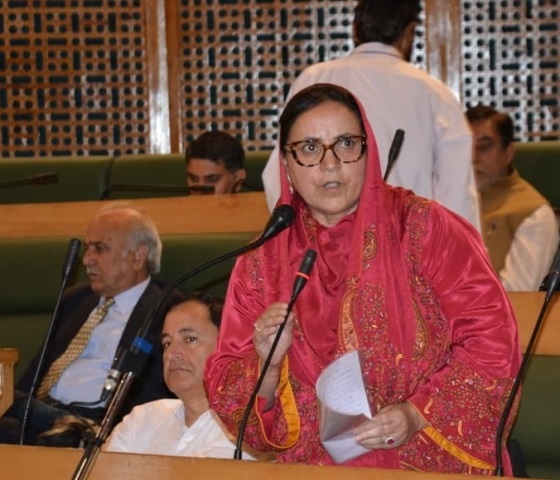
Srinagar, September 24 (KIP)-Minister for Education, Sakeena Itoo today informed the J&K Legislative Assembly that the issue of maintaining the Pupil-Teacher Ratio is being addressed by providing additional staff to understaffed schools through rationalisation across J&K, including those in Uri constituency
Replying to a question raised by MLA Uri Sajjad Shafi during Question Hour of the ongoing Autumn Session of the Legislative Assembly, the Minister said the staffing requirements of schools with relatively higher PTR are being addressed through the ongoing rationalisation process.
She said that only 10 out of 375 government schools in Uri constituency have a Pupil-Teacher Ratio (PTR) of more than 40, while steps are underway to address staffing requirements in these schools through rationalisation and judicious deployment of available teaching resources
Sakeena Itoo said applications from eligible teachers have already been invited under the Annual Transfer Drive (ATD)-2026, and these applications will be considered with due regard to the staffing requirements of schools having relatively higher pupil-teacher loads, wherever warranted.
The Minister further informed the House that 22 Laboratory Assistants have recently been promoted as Teachers, of whom eight have been adjusted in Uri constituency. In addition, five Masters have been transferred to Uri constituency to supplement the existing teaching arrangements, particularly in schools where the pupil-teacher load is relatively higher.
Sakeena Itoo added that the rationalisation exercise for the current academic year has already been initiated and the staffing requirements of individual schools will be duly considered as part of the exercise to ensure a more balanced distribution of teaching personnel.
12.89 lakh farmers covered under PMFBY; 3.72 lakh claims amounting to ₹221.71 crore registered
J&K’s horticulture sector supports livelihoods of nearly 35 lakh people, contributes around 10% to UT’s GDP: Javid Dar
Minister for Agriculture Production, Rural Development and Panchayati Raj, Cooperative and Election Department, Javid Ahmad Dar, today informed the Legislative Assembly that the horticulture sector remains one of the key pillars of Jammu & Kashmir’s economy, supporting the livelihoods and employment of a large section of the population.
The Minister was responding to a clubbed question raised by MLAs Pirzada Farooq Ahmed Shah, Ghulam Mohi-ud-din Mir and Irfan Hafiz Lone, along with the supplementary raised by MLA Shabir Ahmad Kullay.
Javid Dar said that approximately 35 lakh people, comprising nearly 7.5 lakh families, are directly or indirectly associated with the horticulture sector. The sector contributes approximately 10 per cent to the Gross Domestic Product (GDP) of the Union Territory and generates an estimated annual income of around ₹12,000 crore.
He further stated that horticulture has considerable employment potential, with one hectare of orchard area generating approximately 400 man-days of employment annually, thereby making a significant contribution to rural livelihoods and the broader economy of J&K.
On crop insurance, the Minister said that the Pradhan Mantri Fasal Bima Yojana (PMFBY) is presently being implemented across all 20 districts of Jammu & Kashmir.
He informed the House that the scheme is demand-driven and there is no cap on the number of farmers who can avail its benefits, subject to prescribed guidelines and eligibility criteria. He said that approximately 13.985 lakh Farmer Families (FoFs) in the UT are eligible to avail the benefits of the scheme.
As per the available data, 6,86,741.37 hectares of area has been covered, benefiting 12,89,917 farmers, while 3,72,134 claims have been registered involving an amount of approximately Rs 221.71 crore.
The Minister acknowledged that farmers and orchardists in various areas have suffered losses due to natural calamities, including hailstorms, floods and heavy rains.
He said that the Department undertakes assessment of crop losses through its field functionaries and extends assistance and relief, wherever admissible, under the provisions of applicable schemes and guidelines.
Javid Dar stated that PMFBY provides insurance coverage against notified natural risks, including hailstorms, for notified crops. The basic cover provides area-based insurance against yield losses in standing crops from sowing to harvesting arising from non-preventable risks such as drought, dry spells, floods, inundation, widespread pest and disease attacks, landslides, natural fire due to lightning, storms, hailstorms and cyclones, subject to notified crops, areas and applicable guidelines.
Addressing the issue of pending claims, the Minister said that the major reasons for pendency of genuine claims include Aadhaar non-verification, closure of bank accounts, non-seeding of Aadhaar with the NPCI mapper by banks, and bank accounts being blocked or frozen.
He said that the Government has launched a special campaign to resolve failed payment transactions and facilitate settlement of eligible pending claims.
“Approximately 60 per cent of the affected farmers have already been contacted, and the requisite documents are being collected from them on a daily basis for verification and further necessary action,” the Minister said.
He assured the House that concerted efforts are being made to address the genuine difficulties being faced by farmers and ensure that eligible beneficiaries receive the benefits due to them under the scheme.
On the transportation of horticultural produce during the peak fruit season, Javid Dar said that the Government has strengthened traffic and logistics management through coordinated measures to ensure smooth, timely and uninterrupted movement of fruit and other horticultural produce.
He informed that a dedicated Control Room has been established at Qazigund for real-time traffic monitoring, coordination with concerned agencies and dissemination of timely advisories to growers, traders and transporters.
The Minister said that the Mughal Road is also being utilized as an alternative route, wherever feasible, to ease congestion and reduce pressure on NH-44.
He further stated that railway parcel, goods and freight services from Anantnag and Budgam to Delhi have been facilitated and promoted for transportation of horticultural produce.
“These coordinated measures are aimed at diversifying the transportation network, reducing dependence on NH-44 and minimizing the possibility of prolonged stranding of fruit-laden vehicles during the peak harvest season,” Javid Dar said.
The Minister reiterated the Government’s commitment to protecting the interests of farmers and orchardists, strengthening crop insurance mechanisms, expediting settlement of genuine claims and improving transportation, logistics and market connectivity for horticultural produce across Jammu & Kashmir. He further stated that various schemes under HADP the farmers get benefits and avail more than 60 percent subsidies in the projects.