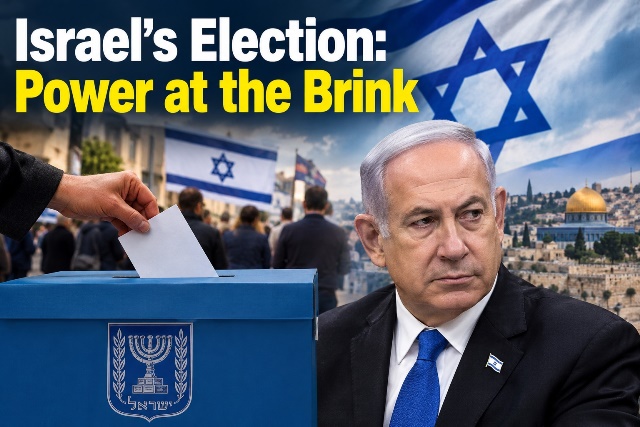
Israel’s Election: Power at the Brink
26/10/2026
Asad Mirza
Israel’s October 27 vote is a referendum on leadership after three years of war, but its consequences reach far beyond the ballot: from Gaza’s future to Iran, Washington and regional stability.
Benjamin Netanyahu’s political strength rests on a potent argument: that Israel faces existential threats and that he alone has the experience and resolve to confront them. He has presented the wars involving Gaza, Lebanon and Iran as evidence that his government has weakened Israel’s adversaries. For voters whose overriding concern is security, that record can outweigh anger over the October 7, 2023, security failure.
Netanyahu’s resilience-and his vulnerabilities
Yet, the same attack is his most serious liability. It exposed a catastrophic breakdown on his watch, and he has resisted calls for a state commission of inquiry. His opponents argue that accountability cannot be postponed indefinitely-and that the prime minister’s personal and political interests have distorted decisions about the war. The issue resonates with bereaved families, displaced communities and Israelis who want an explanation as much as a promise of future protection.
The final polls suggest a close contest, not a clear mandate. Gadi Eisenkot’s Yashar party has led Likud in several surveys, but neither the opposition nor Netanyahu’s bloc appears close to the 61 seats required to form a government. Israel’s proportional system turns the result into a coalition puzzle: small parties hovering near the 3.25% electoral threshold could determine which bloc has the better chance. Even a nominal opposition lead may not translate into power.
Netanyahu also retains a dependable right-wing base, while some voters radicalised by October 7 may shift further right rather than toward the opposition. His campaign’s “No Surrender” message addresses genuine public fear and appeals to voters who believe military pressure is the only language Israel’s enemies understand. His rivals face a difficult task: persuading those voters that a change of government can deliver security, not merely a different style of leadership.
Why the opposition has rallied
The opposition’s energy comes from a convergence of grievances, not a single policy platform. Demonstrators have demanded an inquiry into October 7, criticised Netanyahu’s handling of the war and protested what they see as threats to democratic institutions, including his efforts to curb judicial power. The draft exemption for ultra-Orthodox men is another flashpoint: many Israelis resent bearing military and economic burdens that are not shared equally. Eisenkot has pledged to enforce court rulings on conscription and establish an inquiry, giving discontent a candidate with military credentials.
Eisenkot’s personal profile matters. A former army chief, he has presented himself as a restrained, relatively unshowy alternative who understands security but is not identified with Netanyahu’s political style. His family’s losses in the Gaza war deepen that credibility for voters who want a new direction without being branded naïve about threats. The opposition has also drawn support from Israelis worried about the economy, education and social cohesion-not only the conduct of the war.
But “change” is a broader label than a settled programme. The opposition has not agreed on a successor, and its parties disagree over whether to cooperate with Arab parties, whose support may be crucial to reaching a majority. Nor does a victory promise a sharp break on Palestinians: major Jewish opposition leaders reject full Palestinian statehood, and Eisenkot has described a future arrangement in terms of autonomy under Israeli security control. The bloc is more united against Netanyahu than it is on the country’s destination.
Gaza: a change in tone, not an immediate reversal
For Palestinians in Gaza, the election is consequential but offers little prospect of quick relief through a change of government alone. Netanyahu has ruled out Palestinian statehood and has framed the war as necessary to defeat Hamas. Eisenkot, meanwhile, has said Hamas rule should end within 18 months, through a US-led plan or military means. He has also cautioned against expecting an immediate troop withdrawal from Gaza. The two camps differ in approach and political tone, but neither has offered a clear route to Palestinian sovereignty.
A Netanyahu victory would likely strengthen the influence of right-wing coalition partners who favour continued military control and settlement expansion. That could narrow the space for a negotiated political settlement and deepen Palestinians’ fears of further displacement and dispossession. An opposition victory might bring greater restraint on settler violence in the West Bank and a more diplomatic approach to regional initiatives. But Gaza’s suffering would not automatically become a priority for a government whose voters largely see security, not Palestinian statehood, as the central question.
The most immediate difference may therefore be whether policy is tied to a credible ceasefire and reconstruction framework, rather than whether Israel abandons its security demands. Without an enforceable arrangement, political change in Jerusalem could alter the language and international engagement while leaving Palestinians exposed to continued military control and an uncertain future.
Iran: deterrence, domestic politics and the two-day risk
Iran is both a genuine strategic concern and a powerful campaign issue. Netanyahu has warned of possible Iranian or proxy attacks around the vote and vowed to prevent Iran from acquiring nuclear weapons. His rhetoric has escalated sharply: he posted an AI-generated image of a nuclear blast over Tel Aviv and invoked the danger of a “second Holocaust” if voters reject him. Such messages can rally supporters, but they also risk intensifying public alarm and encouraging miscalculation.
Reports of tension between Netanyahu and IDF Chief of Staff Eyal Zamir sharpened concern. Israeli media, citing anonymous sources, reported that Zamir sought further deliberation and written legal authorisation for an unspecified military action that could trigger a confrontation with Iran. The reports did not establish that an attack had been ordered or that a strike was imminent; Netanyahu dismissed the account as “nonsense.” The military chief was also reported as saying there was no operational need to strike Iran before the election.
The chance of an Israeli attack in the next two days cannot be responsibly quantified from reports. The timing is plainly sensitive: an attack could provoke retaliation, disrupt voting or strengthen the incumbent’s security narrative, while a deliberate pause could reduce escalation risk. The reported military resistance, the political cost of a wider war and the uncertainty of Iranian retaliation all argue against treating an imminent attack as inevitable. The risk is real; certainty is not.
Washington and the regional stakes
The US posture is unusually visible. President Donald Trump publicly endorsed Netanyahu and urged Israelis to vote for him, an intervention that signals closeness but also risks making the election appear entangled with American politics. At the same time, reporting that White House officials were alarmed by Netanyahu’s nuclear-blast post suggests Washington is concerned about escalation and misinterpretation, not simply aligned with every campaign move. The United States may prefer continuity with a familiar leader, yet it also has reason to avoid being pulled into another regional conflict.
A Netanyahu win would likely preserve a confrontational posture toward Iran and the existing hard line on Palestinian statehood. An opposition-led government could improve Israel’s relations with Washington, European states and Arab neighbours by changing its tone and acting more firmly against settler violence. But analysts see limited prospect of a rapid foreign-policy reversal: Israeli consensus remains hawkish on Iran and resistant to a sovereign Palestinian state.
The wider danger is less a single election-night decision than a chain reaction: a fragile coalition, contested legitimacy, an Iran crisis and continued devastation in Gaza. A victory for either bloc may not settle Israel’s divisions; a deadlock could prolong Netanyahu’s tenure while coalition talks stall. The election can change who governs. It cannot, by itself, resolve the conflicts that have made security the campaign’s dominant language-and that will continue to shape the region after the ballots are counted.
(Asad Mirza is a New Delhi-based senior commentator on national, international, defence and strategic affairs, environmental issues, an interfaith practitioner, and a media consultant.)
Disclaimer: The views, observations and opinions expressed in above write up of KIP News are strictly author’s own. Kashmir Independent Press (kipnews.in) News does not take any onus or liability for the veracity, accuracy, validity, completeness, suitability of any of information in the above given write up. The information, facts or figures appearing in the write up in no way manifest the position, standpoint or stance of Kashmir Independent Press (kipnews.in) and the kipnews.in does not assume any encumbrance or answerability of the same. All disputes are subject to the exclusive jurisdiction of competent Courts and Forums in Jammu City Only.)
Editor
Kashmir Independent Press(kipnews.in)