IIPA Hosts 16th Sat Paul Sahni Memorial Lecture
Technology have democratized journalism with challenge of Fake News: Dr Arun Joshi
22/11/2026
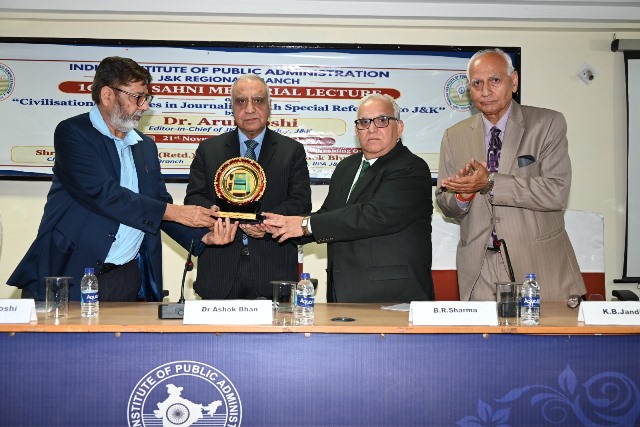
Jammu, November 22 (KIP)-Veteran journalist and currently Editor-in-Chief of JK News Today, Dr. Arun Joshi delivered the 16th Sat Paul Sahni Memorial Lecture, was hosted by the Indian Institute of Public Administration (IIPA), J&K Regional Branch (IIPA), exploring how technological advancements and artificial intelligence have democratized journalism while intensifying the spread of fake news. He detailed the historical evolution of Jammu and Kashmir's media landscape, highlighting regional trust deficits, the impact of the 1990s insurgency, and the shifts following the abrogation of Article 370.
B R Sharma, Chairman of the IIPA J&K RB was the Chief Guest and Dr Ashok Bhan, Patron Presided over the memorial Lecture at jam packed IIPA’s Seminar Hall, attended by members of the civil society, Central Govt Pensioners’ Welfare Association, IIPA, academicians and a large number of students of Journalism/ Mass Communication of Jammu University, Indian institute of Mass Communication, MIET and CUJ. Among the audience was the grand daughter-in-law of Sat Paul Sahni, Mrs Harpreet Kaur.
Speaking on "Civilizational Changes in Journalism with Special Reference to J&K," Dr. Joshi said that technology has revolutionized journalism, driving unprecedented changes over the last few decades. Events like wars now stream live onto smartphones and into drawing rooms, triggering instant reactions in global markets and geopolitical strategies. Describing this shift as the "democratization of journalism," he pointed out that viewers form and share opinions immediately. However, he cautioned that journalism is now no longer the sole preserve of qualified professionals. Anyone with a smartphone can transmit events long before news portals or newspapers report them, making it difficult to distinguish fact from fabrication—a challenge further compounded by Artificial Intelligence. Calling this the "peril of technology” he said that the world must navigate, adding that the history of technology is far from finished.
Drawing on his four decades of experience, Dr. Joshi categorized these civilizational shifts into three parts: technology, content and concoction, and human knowledge and behaviour. Illustrating the technological leap, he recalled Radio Kashmir set up a makeshift studio on Shankaracharya Hill in September 1982 for a panoramic view of Sheikh Mohammad Abdullah’s funeral procession—a feat drones now accomplish with far superior audio and visual clarity.
Talking about content and human behaviour, Dr. Joshi observed that journalism in Jammu and Kashmir has historically been divided into two distinct camps. Local reporters, shaped by their immediate political environment, largely blamed Delhi for Kashmir’s troubles, whereas correspondents for national newspapers often framed stories to suit New Delhi’s narrative. Meanwhile, international media, including Radio Pakistan, pushed entirely different angles driven by ideological clashes and tailored for their specific audiences. He stated that news content was frequently "peppered with concoction" to pander to respective audiences, concluding that "Kashmir was never reported as it was."
He also highlighted the trust deficit between the Jammu and Kashmir regions, explaining how it spilled into local reportage and editorial interpretations. While Kashmir received extraordinary media attention, Jammu remained underrepresented—an imbalance he attributed to mindset rather than technological inequality. Tracing the growth of English dailies in Jammu during the late 1980s, he noted that while Urdu papers like Sandesh and Raftaar were already there in Jammu, the rise of Kashmir Times and Daily Excelsior transformed the regional media landscape and drove local readership. He noted that while Kashmir Times carried an anti-establishment stance tilted toward Kashmir, Daily Excelsior championed Jammu-centric aspirations and later, became a vital voice for Kashmiri Pandit migrants. In Kashmir, Greater Kashmir hit the stands in the Valley in 1993 and became popular even there were well circulated Urdu dailies.
Dr. Joshi identified the outbreak of terrorism in the 1990s as another major turning point that altered both public thinking and reportage, leaving media narratives deeply imprinted on people’s hearts. He described this era as a "civilizational dilemma" marked by constant twists, pervasive concoctions, and human behaviour tuned toward survival and "safety valves." Another defining phase followed the abrogation of Article 370. Referring to the elimination of the last local militant commander, Latif, he observed that Kashmir is now witnessing a shift in mindset—an emerging realization that there is "no need to commit suicide."
Concluding his lecture, which was punctuated with personal anecdotes, Dr. Joshi emphasized that while technology has transformed every facet of the profession, the fundamental challenge remains unchanged, leaving the audience with a pointed question: "Do we uphold our civilizational commitment to journalism?"
In his address, Dr Ashok Bhan lamented the erosion of editorial gatekeeping, noting that platforms like X and LinkedIn allow news to break instantly while users shape the public agenda. He observed that while the evolution of print media was inevitable with the rise of electronic media, social media, and now AI, shifting values and the purchasability of news have deeply impacted classical journalism. The simple pleasure of reading a morning newspaper over a cup of tea, he said, is now vitiated by swarms of propaganda, fake news, and perception management.
Dr Bhan warned that a flood of AI-generated content has caused a widespread decline in originality and public trust, leaving traditional outlets with shrinking audiences as digital channels capture over 70% of global readership.
Remembering Sati Sahni, Dr Bhan praised his credibility, his art of influencing public opinion, and his boldness in acting as a true watchdog for the people. His defining trait was the courage to speak truth in both peace and conflict—grounded in the belief that truth can never be buried permanently. Urging the audience to reflect on whether the era of traditional media is over, Dr Bhan noted that while the fourth pillar of democracy may appear to be collapsing from afar, a closer look offers optimism. Traditional media must survive, he stressed, as its demise would deal a severe blow to democratic principles.
Earlier, B R Sharma highlighted the press's traditional mandate: informing citizens, holding governments accountable, simplifying complex socio-economic developments, and giving voice to marginalized communities. Regrettably, he noted, the relationship between journalism and democracy is far from harmonious. Governments seek to influence the press, commercial interests distort editorial priorities, political groups use media for propaganda, and outlets themselves can become centers of concentrated power. The core challenge today, he said, is not merely securing press freedom, but ensuring responsible and independent journalism.
Looking ahead, Sharma called for a fundamental shift in the profession—moving from immediacy to accuracy, sensationalism to significance, polarization to dialogue, mere information to knowledge creation, and technological dependence to ethical independence—so that journalism becomes an instrument of civilizational renewal.
At the outset, K B Jandial, Vice Chairman of IIPA, paid rich tribute to Sat Paul Sahni, describing him as one of the foremost trailblazers of post-independence journalism in Jammu and Kashmir. He noted that Sahni will be remembered across his many roles as a journalist, broadcaster, author, analyst, tourism promoter, public relations practitioner, and administrator.
Prof Anil Gupta, Joint Secretary of IIPA, conducted the proceedings and presented the formal vote of thanks.